


EU Inc.: Your Future European Company?
With the EU Inc. proposal, the European Commission is taking an important step towards a more modern and integrated European business environment. The idea is simple, yet ambitious: to create a corporate framework that would coexist alongside existing national company forms and allow businesses to operate across the European Union in a simpler, faster and more digital way.
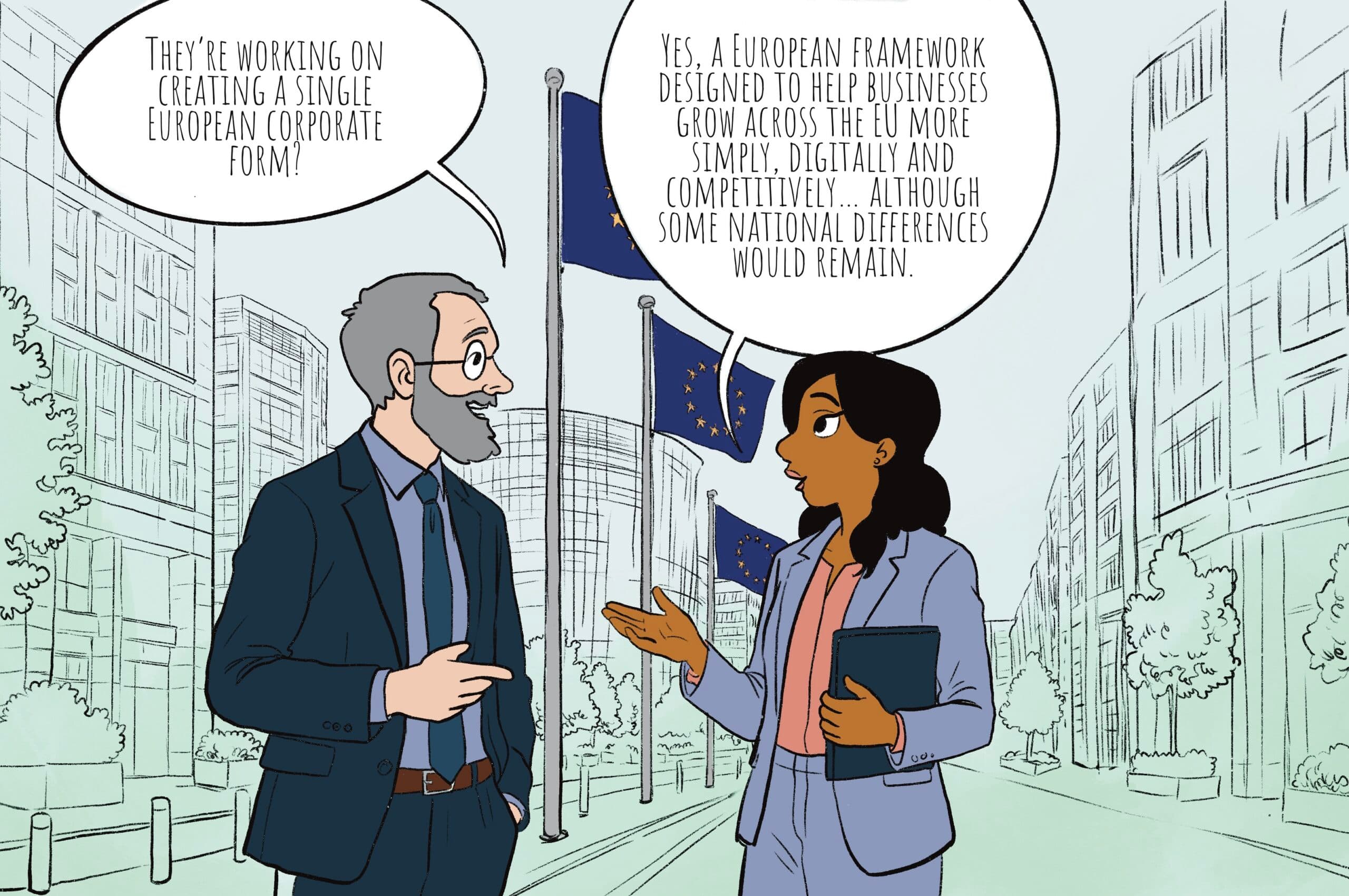
The reason is clear. Although the European Union benefits from an internal market, businesses still face, in practice, diverging national rules, formalities and administrative procedures. For start-ups, scale-ups, investors and international groups, this fragmentation remains a barrier to growth, financing and cross-border expansion.
The EU Inc. aims to provide a pragmatic response to these challenges.
The proposal notably provides for a fully digital incorporation process, with an intended incorporation period of 48 hours and a maximum cost of EUR 100 where standard model articles are used. It also introduces the “once only” principle: information already available in public registers should no longer need to be submitted repeatedly. In addition, the opening of branches, the use of digital powers of attorney, electronic decision-making and the exchange of corporate information through European systems would be simplified.
The relevance of the EU Inc. goes beyond administrative simplification. The proposal also provides for a more flexible framework for financing and governance. Similar to the Belgian BV/SRL, no minimum capital requirement would apply, shares without nominal value could be issued, and flexibility would be provided for different share classes, warrants and employee stock option plans. In this way, the EU Inc. aims to better meet the expectations of investors, start-ups, scale-ups and fast-growing businesses.
The proposal also seeks to facilitate easier access to financing and a more efficient corporate lifecycle, for example by enabling rapid scaling while also providing for a more streamlined winding-up process in the event of business failure.
This is precisely where the attractiveness of the proposal lies. A European corporate form that is digital, flexible and suitable for cross-border use could become a useful instrument for businesses active in several Member States or seeking to attract investment within a European context.
At the same time, a degree of caution remains appropriate. The EU Inc. will not entirely remove the existing complexity. The regime would remain hybrid in nature: European rules would be combined with the company’s articles of association and, for non-harmonised aspects, with national law. As a result, the practical application of the EU Inc. may differ between Member States. The risk therefore exists that, rather than creating one fully uniform EU Inc., several national variants could emerge within a common European framework. The choice of Member State, the specific drafting of the articles of association, tax aspects, governance arrangements and investor protection would therefore remain important considerations.
This does not make the proposal any less interesting. On the contrary, it mainly confirms that the EU Inc. will not be a one-size-fits-all solution, but rather an instrument that will need to be assessed strategically. For some businesses, it may become an efficient and future-oriented option. For others, an existing national corporate form may remain better suited to the company’s specific needs.
For Andersen, this is a development that deserves particular attention. The proposal touches upon issues that are strategically relevant for many investors and businesses today: how to structure growth, organise governance, attract capital and build a more efficient European presence.
The EU Inc. is not yet an operational reality today. However, the proposal does open an important debate on the future of doing business in Europe. It does not offer a miracle solution, but it could become a new instrument enabling European businesses to grow in a simpler, more digital and more competitive way.
As this development continues to take shape, it will become easier to assess the opportunities it may create in practice. For now, the EU Inc. is above all a development that deserves to be followed with attention, realism and genuine interest.
Discover more about this topic?
I am looking for a specialist in













See more articles

05.11.2026
•Real Estate, Renting and Co-ownership, Andersen in Belgium
New rules tighten requirements for sustainability claims in the real estate sector
Sustainable, green, energy-efficient or even climate-neutral: these terms have become commonplace in real estate communications. From the end of September, however, the use of such claims will be subject to stricter rules. The new rules aim to better protect consumers against misleading environmental claims. For businesses, the message is clear: commercial communications will need to be more precise.

05.11.2026
•Employment Law, Andersen in Belgium
Belgium imposes new workplace regulations
Employers must make sure that their internal policies are up date according to Belgium’s PIA and prepare for a stricter time registration obligation.

03.11.2026
•Tax Law, Andersen in Belgium
No Exact Correlation Required Between Expenses Relating to a Holiday Residence and Benefits in Kind
In its judgment of 18 June 2026, the Belgian Court of Cassation settled an important question concerning the deductibility of expenses incurred in making a holiday residence available to a company director: must these expenses be capped at the amount of the benefit in kind (BIK) taxed in the hands of the director? The Court answered in the negative.

03.11.2026
•Tax Law, Andersen in Belgium
Copyright and Tax Abuse: The Court of Cassation Gets Its Wires Crossed!
In a rather surprising judgment of 14 September 2026 (F.23.0097.F), the Belgian Court of Cassation failed to correctly identify the legislature's objectives when introducing the flat-rate tax regime for copyright and related rights income. The courts should swiftly distance themselves from this judgment!